Let me tell you a story about digital transformation — but also about how I understand research.
Over the last few years, I have been involved, together with colleagues I deeply admire, in a large research project based on in-depth interviews with policymakers responsible for digital education in Spain’s Autonomous Communities. The overall aim of the project (which began as a commission from the European Union’s JRC) was to understand how educational digital transformation was being articulated within a deeply decentralised system, in constant dialogue with European frameworks and tools such as DigComp, DigCompEdu, DigCompOrg or SELFIE.
From that same body of empirical work, three different outputs emerged: one report and two academic articles. They share data, but they do not do the same intellectual work. And I think it is worth explaining why.
The report: describing what is happening
The first question we asked was as basic as it was necessary (and it was the one the EU was particularly interested in, in order to understand its policy impact across Member States): What are regional governments actually doing with European frameworks and tools?
The result was the policy research report Strategic Approaches to Regional Transformation of Digital Education, published by the JRC (https://publications.jrc.ec.europa.eu/repository/handle/JRC134282) . Its function is mainly descriptive and comparative: mapping decisions, identifying patterns, making territorial differences visible, and offering a clear overview of how these instruments are (or are not) being used.
It is a text designed for policymakers, technical staff, and those who need a well-documented snapshot of the situation. It answers the what.
However, once that question had been answered and the report completed, the data we had collected began to set off a few “alarm bells” in our heads — about deeper issues related to the mechanisms that had shaped that what.
So we went back to the data with two further questions that were no longer simply about what is happening, but about why it happens — or what that might suggest. In particular, we found ourselves circling around two questions.
How is digital transformation being led?
Here, the focus shifts away from the instruments themselves and towards the leadership strategies articulated by governments: whether they approach transformation through more guided models, more empowerment-oriented approaches centred on teachers, or hybrid combinations of both.
This line of inquiry gave rise to the article Educational empowerment and strategic guidance, published in the European Educational Research Journal ( https://doi.org/10.1177/14749041251398083 preprint is available here 2025_ERJ_Preprint ). The paper offers an analytical reading of leadership styles in contexts of digital transformation, starting from the characterisation of two ends of a leadership continuum. It pays attention to professional agency, power distribution, and the contextual conditions that push decisions in one direction or another.
European frameworks are still present, but mainly as resources embedded within broader strategic approaches.
What do instruments do politically when they are put to work?
The second conversation took us somewhere else. This time the question was: what do frameworks and tools do politically when they are used in processes of educational digital transformation?
Here, analysis and discussion move the focus squarely onto the instruments themselves. They are not treated as neutral supports, but as technologies of governance: devices that structure discourse, legitimise decisions, organise certification processes, and mediate — very concretely — the tension between European alignment and regional autonomy.
From this analysis came the article Governing digital education in decentralised systems, published in the Journal of Education Policy ( https://doi.org/10.1080/02680939.2025.2610833 preprint is available here PREPRINT2025_EdPolicy ). This text does not classify leadership styles or propose typologies. It examines mechanisms: how categories, benchmarks and self-assessment routines become part of the material fabric of education policy.
Why three publications? Do we really need all three? I believe we do.
None of these publications replaces the others. Together, they allow us to trace a path from description (what is happening), to strategy (how it is being led), and to governance (how instruments actually operate).
Explaining this trajectory is not just a matter of academic transparency. It is also a way of showing that, when we talk about digital transformation of education, education policy — and especially European education policy — it is not enough to know what is being adopted. We need to understand how it is translated, how it is led, and how it governs.
I often tell people finishing their PhDs that a good researcher is not someone who simply collects data and describes it efficiently. A good researcher is someone capable of asking questions that push just a little beyond description — someone who is able to ask more, and better, questions. And I deeply miss questions in academic publications: good questions — uncomfortable ones, genuinely uncertain ones — that make me think, that invite me to share in the authors’ thinking.
We could, of course, adopt a more cynical stance and say that in the world of “publish or perish”, the more publications you squeeze out of a dataset, the better. But I find that cynicism rather empty. Especially because — and I insist on this — there comes a point in an academic career (if it hasn’t happened to you yet, believe me, it will) when the sprint ends. And at that point, it becomes worth investing in work that actually means something: work that makes you think, and that makes each inquiry lead you to find things that genuinely interest you.









 Hace unos días twiteaba (si, también twiteo –




 Desde hace un tiempo, desde estos mundos de la educación y además desde los de la economía y la empresa, se ha venido diciendo eso de que los procesos de resolución de problemas son más eficaces cuando se hacen en equipo.
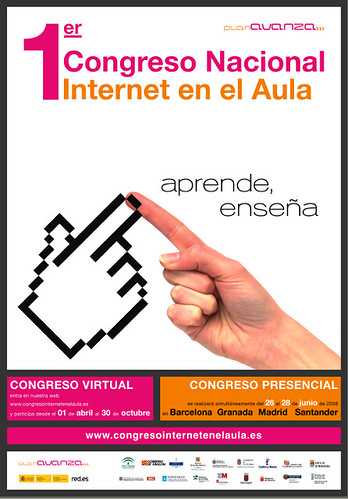
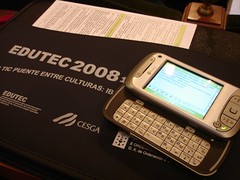
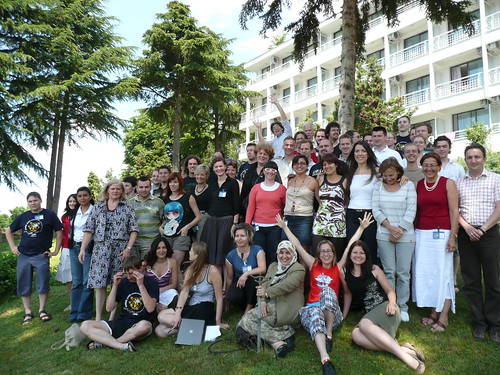
 Después de tanto tiempo, una de congresos. He de decir en mi descargo 😉 que llevo unos cuantos días sin escribir por motivos enteramente profesionales… bueno, vamos a dejar lo de “enteramente”… El caso es que la semana pasada asistí junto con algunas compañeras al Congreso MICTE en la siempre bonita (aunque ahora parezca una yacimiento arqueológico) ciudad de Sevilla y me gustaría comentarlo, de forma siempre constructiva (o al menos eso espero). Los congresos son lugares de intercambio en los que compartir un poquito del trabajo que hacemos en investigación, conocer el trabajo de otros y aprender cosas interesantes de otros más expertos que nosotros mismos quienes suelen hacer parte de dichos eventos… en fin! hacer relaciones con gente interesante de otros entronos diferentes y con la que compartimos intereses comunes. Desde ese punto de vista cualquier persona podría organizar un congreso científico, de hecho así lo es… y desde este punto también podría decirse que cualquier congreso puede ser un éxito rotundo, en tanto que puedes compartir con otra gente que siempre, en mayor o menor medida, resulta interesante. Pero yendo más allá, el prestigio y la solvencia de un congreso internacional está dado a mi gusto en primer lugar por la calidad y rigurosidad de sus intervenciones plenarias (ponencias, mesas redondas, etc.), de sus comunicaciones y de su organización. En estas tres cosas creo que el MICTE podría mejorarlas sustancialmente. Da la impresión de que se trata de una reunión en la que se aceptan todas las contribuciones sin ningún tipo de filtro… se evalúa un abstract de dos párrafos y se recibe una comunicación de 5 páginas, última que no es evaluada. Además, si se hace una visión somera de lo que ha sido aceptado como comunicación oral y lo que ha sido seleccionado como poster se evidencia que TODAS las comunicaciones orales son presentadas por extranjeros (2 excepciones entre más de 500 contribuciones). Entiendo que hay quien piense que el nivel científico del exterior pueda estar muy por encima de la producción científica nacional, sin embargo sorprende que, viendo los muy relucientes nombres que aparecían en el listado de abstract aceptados, ninguno más hubiese dado la talla para una exposición oral… (la sorpresa es mayúscula cuando escuchabas el contenido de algunas de dichas intervenciones). No hay ni una sola ponencia plenaria, ni un stand, ni un experto, ni una mesa de debate… sólo sesiones de póster y sesiones de comunicaciones… vale, entiendo que es para facilitar el intercambio entre congresistas… pero… ¿en sesiones de más de 30 comunicaciones por turno, es posible dicho intercambio? ¿realmente es práctico? Todo lo anterior aderezado con pequeñas cosas de organización, como la ausencia de actas para todos los congresistas (los estudiantes no recibían las actas, sólo una separata de la comunicación en caso de tenerla), la poca publicidad, la ausencia de trasnsporte desde lugares clave de la ciudad (teniendo en cuenta que es un congreso con tanto participantes extranjero) no es mucho, pero hace. Me temo que el “sabor de boca” final de este congreso es más amargo de lo que me gustaría… espero que para el futuro todos tomemos nota. Como siempre la gente de sevilla inmejorable! gracias.
