The Lens: looking again

I have been talking about Personal Learning Environments (PLEs) for almost twenty years, and I have always had a slightly uncomfortable feeling: I think that, in the world of techies, we have never been particularly good at selling —or perhaps packaging— the idea. And that really bothers me, because I think it is an incredibly useful idea for helping us stop thinking in the same old ways… and also for building those bridges that might make what we do more complementary.

While preparing The Lens, the second seminar in Educational Optics, I found myself returning to a conversation from 2010, when Ricardo Torres-Kompen, Graham Attwell, lots of other wonderful people and I were preparing the first PLE Conference. We were talking about “the future of PLEs”, and I remember telling them that I didn’t think PLEs had “a” future; rather, they were “the ground” on which we would build that future… In other words, I didn’t think they were “the thing”, but something that helped us think. I have returned to that idea many times, but while preparing this seminar I think I came to understand it differently. Perhaps PLEs have also been a lens through which to watch the future as it arrived. Not because they predicted AI or any of the technologies that came afterwards, but because they helped us think about learning in a way that remains useful as technologies change.

And that is what I wanted to talk about in The Lens: not to explain once again what a PLE is, but to try that lens again.

In the process, Simon Buckingham Shum did something apparently small that I loved. In one of our conversations during my first few weeks here, he heard me talking about the three activities we have traditionally used to explain PLEs —reading, doing and discussing— and suggested repackaging them as the 3Ds: Digesting, Doing & Dialogue. It is not a new model; it is a different way of making knowledge that was already there easier to understand. And after almost twenty years of thinking that perhaps we had never packaged PLEs particularly well, I’ll take all the help I can get.

Then AI arrived. And the question became what that old lens allows us to see now: what does Digesting mean when a first interpretation may already have been produced for us; what does Doing mean when producing something is no longer sufficient evidence of learning; and what happens to Dialogue and to otherness when AI can be an excellent intellectual interlocutor.

As with The Prism, much of the seminar took shape while I was thinking it through: conversations, many hours making and remaking slides, ChatGPT and Claude as interlocutors, and quite a few instances of “no, that’s not exactly what I mean”. And yes, once again I got rather lost in my own metaphors. I still love it.

And at the end I wanted to do something that increasingly interests me: question my own metaphor. If I had spent the whole seminar proposing PLEs as a lens, I didn’t want to finish by pretending that this lens gives us a clean and transparent view of learning. That is how progressive lenses appeared. When you first start wearing them, seeing is not necessarily easier. Some areas are blurred, you misjudge distances, and you have to learn to look differently. The lens allows you to see both near and far, yes, but that expansion of what is visible comes at a cost: the simplicity of the lens you had before.

I think something similar has happened to me with PLEs. After almost twenty years, they have not given me a simple answer to how people organise their learning. They have made it increasingly difficult for me to accept simple answers. And perhaps that is precisely why I still find the idea so useful. In 2010, I said that PLEs were not the future, but the ground on which we would build that future. Today I would add that they have also been a lens through which to watch it as it arrived. A lens that does not necessarily make things clearer, but does allow us to see more.

And I like ending this way, questioning the very metaphor I started with. Because if a lens helps us look critically at education, perhaps the least we can ask of it is that it can withstand being looked at critically too.

I’m leaving the full recording of the seminar here, in case you fancy having a look and commenting 🙂 or just having a look 🙂

The Prism: Building a Conversation

There is a habit I’ve had for years, and one that I’ve found myself talking about more and more lately. Every time I prepare a series of seminars for an important moment in my academic life—a promotion, a research stay, a keynote that really matters—I don’t just prepare the content. I need to build a language for that particular moment. It’s a kind of ritual that I never consciously planned, but one that I’ve gradually recognised as part of the way I work.

I’m not entirely sure when that process begins. Certainly not when I open PowerPoint. It starts much earlier. It starts by looking—deliberately looking. Looking for images, colours, typefaces, photographs, textures… without yet knowing exactly what I’m looking for. If anyone had watched me during those weeks, they would probably have thought I was wasting an extraordinary amount of time. There were entire days when I didn’t produce a single slide. I would simply look at images, spend twenty minutes trying a different font only to go back to the previous one, replace a photograph because its colours no longer spoke to the rest, move an idea from the beginning to the end and then back again the following day. I do all this because I need to find the tone of the conversation before I can begin to write it. I’ve never thought of slides as supporting a talk; for me, they are part of the thinking itself.

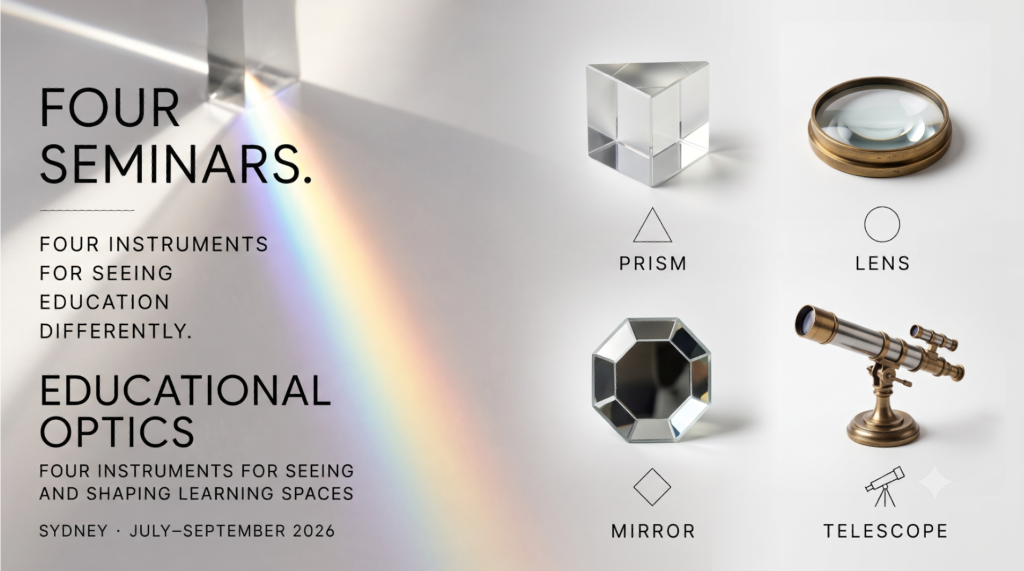
This time I knew two things from the very beginning. I wanted the four seminars to feel like a recognisable series, and I wanted that series to breathe nature. The optical metaphors came almost immediately—The Lens, The Prism, The Mirror and The Telescope—but I didn’t want a technological aesthetic. I wanted water, minerals, vegetation, crystal, light. I wanted each seminar to have its own palette while still feeling as though they all belonged to the same family. I’m always surprised by how much time I’m capable of spending on these things. Every single time I promise myself that this process will be simpler. Every single time exactly the opposite happens. By now I should probably accept that, for me, designing a seminar means spending a very long time looking before I can start writing.

There was another moment that I found unexpectedly revealing. I had the feeling that this series of seminars ought to look… older. Or perhaps more mature. (I have to admit that, lately, I’ve been trying to mature in all sorts of ways. Perhaps because my face has started doing it whether I like it or not…) Not more sophisticated, just calmer. In one of my conversations with ChatGPT, it started suggesting Nordic editorial design: lots of white space, restrained typography, clean layouts, understated elegance. For a while I genuinely thought that might be what I was looking for. It seemed reasonable that the visual language of my presentations should also reflect the fact that I’m no longer at the beginning of my career.

But the more I looked at those designs, the stranger they felt. Not because I didn’t like them. I still think they’re beautiful. The problem was something else: they weren’t speaking my language. And then I realised something that, once it occurred to me, seemed almost embarrassingly obvious. I’m Colombian. I’m also deeply Mediterranean after spending more than a half of my life in Murcia. Muchness is part of the way I see the world. I’m anything but modest or restrained. I think that way. I write that way. My texts are full of layers, metaphors and references that constantly overlap with one another. Trying to make my seminars look as though they had been designed by somebody completely different simply because I’m now a more senior academic suddenly felt rather absurd.

Growing older shouldn’t mean becoming someone else. It should mean becoming more fully yourself and allowing your work to reflect that evolution without giving up the way you naturally look at the world. After all, I can’t really be anyone other than myself. While all this was happening, the seminar itself kept changing.

The Prism was probably the hardest of the four seminars precisely because it came first. In one sense it should have been the easiest: we’d already been working on the AI Prism for almost two years, and it had already generated several publications. But simply turning the seminar into an explanation of the framework… well, as Disney’s Alice would probably say, where’s the fun in that? Anyone genuinely interested in understanding the framework can read the papers. A seminar has to do something different.

The earliest versions walked through the framework almost step by step. Little by little those slides disappeared. In their place came others that barely mentioned artificial intelligence at all. They talked about education. About the traditions through which we think about education. About the questions that each tradition considers important—and the questions it quietly leaves outside the frame.

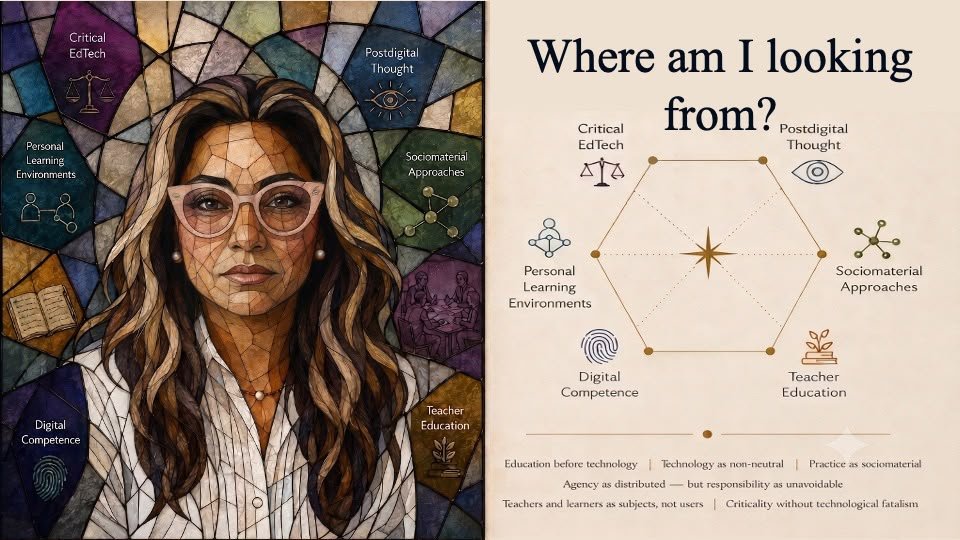
I remember very clearly the moment I realised that the seminar had to begin there. I couldn’t expect people to understand why the AI Prism distinguishes certain dimensions if they didn’t first understand the intellectual traditions from which those distinctions emerged. The framework was a consequence, not the starting point. That is where the opening slide came from—the one that, in different forms, will appear throughout the entire seminar series.

I also started telling stories. Anyone who has ever worked with me—or survived one of my classes—knows that I tell a lot of stories. Some of these came directly from questions that had been following me around during the conferences I’d attended in my first few weeks in Sydney. Those conversations slowly turned into examples, and those examples gradually found their way into the seminar.

There was one final decision that I struggled with. Ending by questioning the prism itself. It felt inconsistent to ask people to adopt a critical perspective on artificial intelligence while presenting my own framework as though it were somehow definitive—especially when I’d already begun questioning the metaphor myself months earlier. So I decided to finish by explaining why the prism had started to feel insufficient. Not because it had stopped being useful, but because every metaphor illuminates certain things while inevitably leaving others in the dark.

As always, another familiar companion appeared somewhere along the way: impostor syndrome. During those weeks I had two remarkably patient interlocutors: ChatGPT and Claude. I showed them endless versions, asked far too many times whether things made sense, whether I was being too ambitious, too complicated or simply too baroque. I wasn’t asking them to write the seminar. I needed them to help me keep thinking at the precise moment when I could no longer tell the difference between an idea that needed more work and one that was simply making me doubt myself.

Then came the seminar itself. And something happened that made me particularly happy. Most of the discussion wasn’t about the seven dimensions of the AI Prism. It was about the questions that had made it necessary to build the framework in the first place. My conversation with Simon Buckingham Shum was probably the clearest example. We talked about personalisation, learning, communities and artificial intelligence, but above all we talked about the educational traditions from which each of us was asking those questions. At one point Simon made an observation that has stayed with me: the danger of turning positions into caricatures when, in reality, they are far more complex than that. I think he was absolutely right.

I left with the feeling that the seminar had achieved exactly what I had hoped it would: it had shifted the conversation away from the framework itself and towards the problem that had made the framework necessary.

I’m sharing the recording of the seminar here.

Not because I think it’s definitive—I always find things I’d change when I watch myself back—but because it’s part of the process. Journal articles tell the story of research once it has reached a certain point. Seminars, at least for me, are where those ideas begin to encounter other people’s thinking and, with a bit of luck, start changing again.

Looking for a Different Conversation

When I started planning my research stay at the Connected Intelligence Centre (UTS), I was quite sure that I didn’t want to come to Australia just to do exactly the same things I do in Murcia, only 17,500 kilometres away and with a more exotic view. A research stay requires a considerable effort from many people, and I have always thought that it is worthwhile only if it forces you, at least a little, to step outside your usual conversations.

For that reason, I never set out to find what would simply be an Australian version of a Faculty of Education. Not because I don’t value them—indeed, I have good friends and collaborators in many of them—but because I was looking for a different conversation. I was interested in something else.

I have followed Simon Buckingham Shum’s work for many years (in fact, ever since I first met him at the KMi twenty years ago). Although his background lies more on the “techie” side—though never exclusively—what has always interested me is that much of his work has tried to understand how people learn together, how they construct knowledge through discourse, how certain learning processes can be made visible, or how technology can help us understand, rather than simply automate, those dynamics.

In other words, I have never seen our research as running in parallel. Nor have I seen it as overlapping. Rather, I have always thought of it as two different ways of approaching some common problems. That is why the CIC seemed such an interesting place for this research stay. Not because I expected to find people who thought like me, but precisely because I expected to find different questions—or different ways of approaching the same questions—about problems that, ultimately, we share.

So when we started talking about giving a seminar (some of the ideas actually came from conversations with Simon during June), I suggested trying something different. What if, instead of a single talk, we used the stay to build a small series? Not a set of independent presentations, but a conversation that could develop over several weeks and address issues that I hoped would also be relevant to the CIC community.

The proposal also responded to something that has become increasingly important in my own work: how to reformulate and repackage my thinking so that it can enter into conversation with people who do not necessarily belong to the same field. That requires a process of translation—not only into English, of course, but also across intellectual traditions, vocabularies and ways of framing problems. It also requires finding ways of presenting ideas that allow others to discuss them from within their own frames of reference.

The four optical metaphors emerged as a way of giving that proposal some coherence. Each one offered a different way of looking at some of the issues I wanted to discuss and, at the same time, an open enough point of entry for those issues to be framed in other ways as well.

The series eventually took shape around four seminars which, taken individually, deal with different topics but are really part of the same conversation. Each starts from a different question, draws on a different part of my work, and puts it into dialogue with issues that I believe also matter to the Connected Intelligence Centre. They were never intended to provide an overview of my research. Instead, they use parts of that research to open up questions that, hopefully, can be shared.

The Prism uses AI as a starting point to ask whether the categories we are currently using to understand it are actually sufficient. Rather than proposing yet another framework, the seminar tries to broaden the conversation and, ultimately, to question the conceptual tools through which we observe the phenomenon.

The Lens revisits Personal Learning Environments, a line of research I have been working on for many years, in order to return to a question that still seems fundamental to me: how do people organise their learning? The emergence of artificial intelligence has made that question, far from becoming obsolete, even more urgent.

The Mirror turns its attention towards the university itself. It uses teachers’ digital competence as a way of discussing something that has concerned me for a long time: how institutions make decisions about teaching, and to what extent many of those decisions are never actually made explicit.

Finally, The Telescope looks towards what is beginning to emerge. It is probably the most open-ended of the four seminars and the one that incorporates the largest amount of work still in progress. The question is no longer what artificial intelligence can do, but what we still want to recognise as evidence that learning has taken place, and what kind of teaching we need when machines begin to do things that, for a very long time, we believed were exclusively human.

Together, the four seminars revisit some of the themes I have been working on over the last few years. More importantly, they try to do so in a way that makes conversation possible with a community that does not necessarily share my disciplinary background. If the series works, I hope people will not see four talks about different research projects, but rather a conversation around a number of questions that we increasingly share, even if we formulate them from different places.

Over the coming weeks, I will write a post about each of the seminars. Not so much to summarise the presentations themselves, but to tell the story of how they were put together, the decisions that shaped them, and the conversations they opened once they had been delivered.

I have to admit that writing these posts feels a little intimidating —perhaps even a bit scary…(in panic actually!) . But there is something of a personal challenge in doing it, and I find that discomfort—my own discomfort—worth paying attention to.

Understanding AI as a Prism, challenging the metaphore

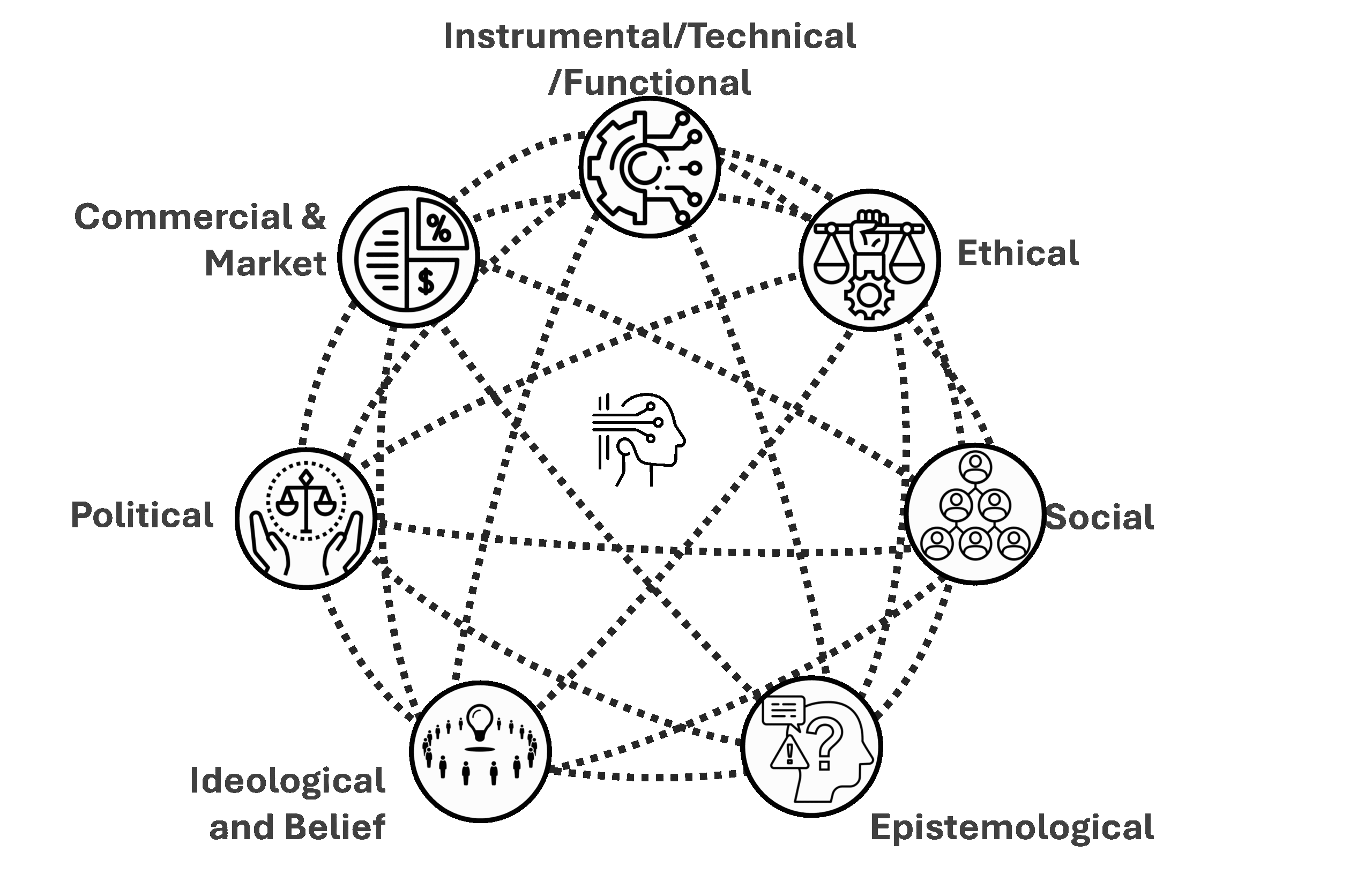
Two new texts have finally been published (you’ll find them at the end of this post), where together with Ana Yara Postigo-Fuentes and Amaia Arroyo-Sagasta we explore the analysis of AI from a prismatic perspective. In these works, we argue that AI—as an educational technology—should be understood through a framework that includes at least seven dimensions: instrumental, ethical, epistemological, ideological, political, social and commercial.

Castañeda, Arroyo-Sagasta, & Postigo-Fuentes (2025)

When Ana Yara, Amaia, and I use the prism metaphor, we do so because, in optics, a prism not only refracts light—it decomposes it and reveals its invisible components. Likewise, thinking of technology as a prism, rather than a simple lens, allows us to understand that its role in education is not merely to transform what we do, but to make visible the multiple dimensions that constitute the “white light” of educational practice—dimensions often assumed or even deliberately ignored. From a postdigital and phenomenological perspective, the technological prism does not act as a filter but as a space of revelation and tension: it confronts us with the complexity of the educational, allowing us to analyze, reinterpret, and reconfigure its different layers—including the instrumental one—alongside others that often remain hidden.

However, using a metaphor can sometimes blind you to the very tensions that the metaphor itself carries. That’s why I’d like to use this space to offer a brief critique of our own metaphor, because I think it contains a few conceptual tensions and what we might call “points of potential contradiction” — or, perhaps better said, optimistic assumptions. Let’s take a look:

  1. The Implicit Neutrality of the Prism (the Problem of the “Neutral Artifact”): The metaphor presents the prism as a neutral instrument that simply “reveals” a pre-existing truth. Yet technology is not neutral. While a glass prism has fixed physical properties and its effect on light is predictable and universal, our argument precisely rests on the idea that educational technology—and AI in particular—is value-laden, shaped by ideologies, commercial interests, and specific designs. Therefore, the technological prism not only “reveals” dimensions; it also configures and creates new ones.
  2. The Assumption of a pure, pre-existing “White Light”: The metaphor assumes that there is a “white light” (educational practice) that is pure and coherent before passing through the technological prism—and that’s false. Educational practice is never that pristine white light; it is always already mediated by its sociomaterial nature. The very idea of an educational essence that precedes technology is precisely what the postdigital perspective questions. For that reason, the technological “prism” does not intervene in a pure practice; it has always been constitutive of it. The metaphor must not be read as implying that technology arrives later to an innocent practice—because that would reproduce the very simplistic view of education we aim to challenge.
  3. The Optimism of “Revelation” The prism metaphor is not meant to suggest that technology—or AI—by itself “reveals,” “makes visible,” or “creates spaces of revelation.” Rather, we should understand the complexity of what it affects (the light). The point is not that technology is an agent of revelation, but that the metaphor of the prism offers a critical framework to examine how, once introduced, technology makes visible the tensions and dimensions that were previously entangled within educational practice. Revelation is therefore an achievement of analysis, not a property of the tool.

It’s important to remember that this image—one that we like very much (I admit, I love it! 😄)—is a powerful but partial metaphor. It highlights certain aspects (complexity, multidimensionality, analytical potential) while obscuring others (non-neutrality, opacity, and the constitutive nature of techne). Its purpose is to shift the conversation away from mere instrumentalism (“how to use a tablet”) toward a deeper reflection (“what the tablet does to our understanding of education”). Yet its rhetorical strength may rely on a view that is perhaps too benevolent toward the role of technology.

So… does that make it invalid? Not at all. I genuinely believe that the prism metaphor offers a conceptual framework to begin a critical discussion—but that critique must start by deconstructing the optimistic assumptions within the metaphor itself. Its value does not lie in being a “truth,” but in serving as a productive catalyst for thought.

For those who’d like to read the full texts and think along with us, here they are:

  • Castañeda, Linda; Arroyo-Sagasta, Amaia & Postigo-Fuentes, Ana Yara (in press). When Digital Literacy Must Go Beyond the Screen: Further Dimensions for Analysing the AI Impact in Education. In Flynn, N., Garcia, P. O., Joseph, H., Powell, D., & Slater, W. H. (Eds.) (in press). The Bloomsbury International Handbook of Literacy. London, UK: Bloomsbury Press.
  • Castañeda, Linda; Postigo-Fuentes, Ana Yara & Arroyo-Sagasta, Amaia (2025). Beyond Tools, Toward Power Structures: A Critical Review of AI in Primary Education. Revista Española de Educación Comparada (48), 73–95. https://doi.org/10.5944/reec.48.2025.45126