As the end of my time in Australia is getting dangerously close —and with it that terrible moment when one has to explain, in a few pages and preferably with some degree of order, what exactly one has been doing for four months— I have spent the last few days trying to look back and put things into some sort of order.
Part of that attempt ended up in my previous post, where I tried to explain what Educational Optics had been and why building those seminars here had turned out to be a rather more important part of my time in Australia than I had anticipated. And, of course, after writing that some of the things I had been absolutely certain I was going to do I will no longer do, that I will do others differently, and that connections have appeared that I want to keep thinking about, I found myself thinking: OK, which ones?
Because, obviously, I did not arrive in Australia intellectually empty-handed —that would have been slightly worrying at this stage—. Many of these questions have been with me for years. But they are not exactly the same anymore.
Building the seminars has had quite a lot to do with that. Because one thing is to spend years working on PLEs, teachers’ digital competence, learning spaces, data, AI or professional judgement, and quite another to sit in front of a blank slide and try to decide what the hell you want to say about all of that now, to these people, how some of those things relate to others and, above all, which parts of what you have been saying for years still convince you and where you are going next.
The seminars are obviously only part of the story. While I was building them, I have had conversations —many of them— with people working on things close to mine and with others looking at them from quite different places; conversations I actively sought out, conversations that happened after a seminar, coffees, meetings, questions someone asked that stayed in my head for considerably longer than was reasonable. And I have had time. Time to prepare, to read, to come back to an idea two days later, to change a slide twenty times —I am not sure that one is actually a good thing— and to follow a question without having to turn it immediately into a deliverable.
So I decided to try to see what had happened to those questions over these months. And, in an exercise in methodological consistency that could be either brilliant or profoundly absurd —I am inclined to think it is a combination of both— I started doing it in conversation with Gemini and ChatGPT.
I did not ask them, “What have I learnt in Australia?”, among other things because I hope to retain at least some responsibility for that question myself. What I did was put on the table the chronology of what I have done over these months (which I am sure I will share, at least partially, in another post soon), seminars, ideas, previous work, conversations, things I had written during these months, and start testing connections. They proposed, I protested; they organised, I disorganised; they found wonderfully neat symmetries and I had to remind them —and myself— that things had not actually happened that way. Sometimes they insisted on finding connections that looked beautiful but simply were not there (AIs are very good at finding patterns, even when the patterns do not exist), and every now and then something appeared that made me think: wait, yes, there is something here.
After going round it quite a few times, this is what emerged.
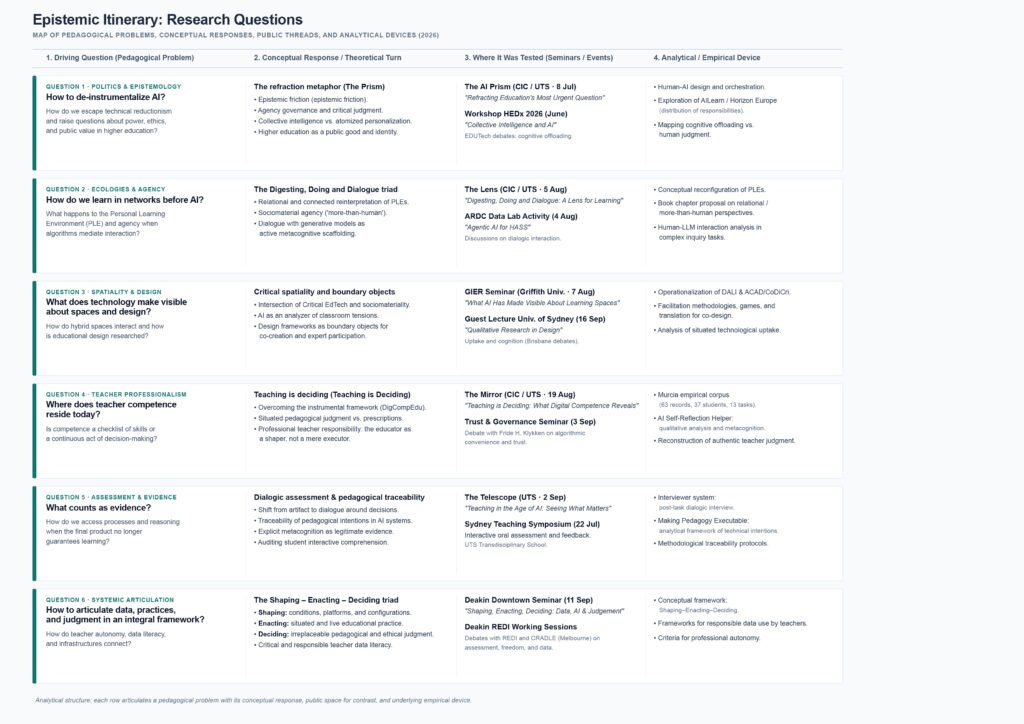
And I like it precisely because it is not a map of my time here, nor a summary of Educational Optics, nor that beautifully tidy “six things Australia has taught me”.
They are six questions. Some have been with me for years, others are more recent, and probably none of them was exactly born here. But over these four months they have passed through seminars, readings, conversations, work that was already underway, people who have helped me think and the luxury —because I do think it is a luxury— of having time to do so. And they have not emerged unscathed.
I do not yet know how much they will change what I do when I go back. It would be rather absurd to pretend that, after four months away, one returns home with a perfectly packaged new research programme ready to execute. But I do know that some of these questions are making me look differently at work that was already underway, reconsider things I had planned to do, and begin to imagine others that were not part of the plan at all.
Perhaps that is why I am so interested in trying to write them down now. Not to turn them into the conclusions of my stay (believe me, right now I am very much in organising-things-to-see-if-I-can-actually-make-use-of-everything-I-have-been-thinking mode… and Chari, Clauda and Gemi are helping me quite a lot with that), but because I suspect they may end up refining —or even, in some cases, redefining— some of the work I do afterwards.
And, by the way, all the seminars are somewhere around here in previous posts or on YouTube. So, if anyone feels like looking at the map and then watching one of them, I would genuinely love to know whether you see the same questions I see, completely different ones, or whether you think Chari, Clauda, Gemi and I have got a little carried away with the connections 🙂
After all, if four months away are only useful for coming back with a checklist of notches for things done, I don’t think that would be quite as cool… Let’s see what you think.
This work is an outcome of research stay 22871/EE/25, funded by Fundación Séneca – Agencia de Ciencia y Tecnología de la Región de Murcia under the Regional Programme for Mobility, Collaboration and Knowledge Exchange “Jiménez de la Espada”.