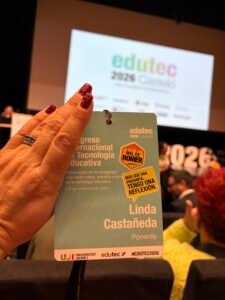
 I’ve come back from Castellón with a few things on my reading list, some ideas I want to explore further, several things I’m still not entirely convinced about, and the lovely feeling of having spent three days thinking alongside some wonderful people.
First things first: EDUTEC 2026 was so beautifully organised! My congratulations and heartfelt thanks to all my people at Universitat Jaume I who worked to make it happen. Organising a conference of this size involves an enormous amount of work, much of which those of us attending never see. And when everything works, when you can feel the care that has gone into the details and, above all, the people, and when there are so many opportunities to meet and talk, it deserves to be said. It was an absolute pleasure. Everything went so smoothly, as Professor Salinas would say…
I also want to thank everyone who contributed to the keynotes, roundtables and other sessions. I attended mainly the roundtables (and took part in one myself — thank you for inviting me! 🙂 —), and I thoroughly enjoyed the diversity of perspectives and experiences shared. I didn’t always agree with everything I heard, but that’s part of what I expect from a conference, too.
As I usually do, I took notes on Bluesky, sharing whatever caught my attention as I listened. They aren’t minutes or summaries of the presentations. They’re rather personal notes: sometimes a reference, sometimes a phrase, sometimes a question that occurs to me while someone is speaking. So I’m not going to reproduce them here. Anyone interested can find them among my posts under #edutec2026. This is something else: a few notes after the notes, now that I’ve had a little time (and some help from Chari) to revisit them.
Things I Loved and Am Taking Away With Me
One of the things I enjoyed most was listening to Melissa Bond again, talking about research, rigour and how we build knowledge in educational technology.
I’m genuinely enthusiastic about evidence synthesis. Good systematic reviews, mapping studies and umbrella reviews are extraordinarily important in a field where we publish so much, using such different approaches, on issues that change so quickly.
And it’s not because I’ve become an ‘evidence evangelist’, or because I believe evidence speaks for itself or that we can derive educational recipes directly from research findings. Quite the opposite. Good syntheses help us understand what we know, but also what we don’t know, where the contradictions lie, which conditions shape the findings, and how far our conclusions can reasonably go. They help us recognise the limits of the evidence, not forget them.
I think this is essential scientific work, and we need to value it much more. Especially now that AI allows us to produce and process information at extraordinary speed, without necessarily solving the problems of interpretation and judgement.
I also loved encountering research that helps us look at educational practice beyond the individual characteristics of the people involved. I was particularly interested in what Mireia Usart shared about the relationship between the physical design of classrooms, digital competence and teaching practices involving technology. And I came away with an idea from Virginia Larraz that sounds simple but has enormous implications: if we want teachers’ professional development, we need to fund time. Not just training, resources or certifications. Time to learn, experiment, talk and reflect on what we do.
I also really liked Wilfried Admiraal’s distinction between epistemic laziness and difficulties in recognising the limits of information. When a student settles for the first answer an AI gives them, is it because they don’t want to dig deeper, or because they lack the criteria to recognise that they should? That’s no small distinction.
And I particularly enjoyed the roundtable on experiences from schools. La Alcoyanada, school radio, projects involving the creation of historical content, young people’s literature… How important it is to keep listening to people doing interesting things in real contexts, with real people and a history behind them.
From Toni Solano, I took away the importance of thinking about the school as the unit of innovation, rather than continuing to rely on individual acts of heroism. And from Julio Pacheco, two questions that I think are brilliant:
How do we demonstrate that learning has taken place? Versus How do we demonstrate what has been learnt?
A tiny linguistic difference (more evident in Spanish that is just an accent), and a world of difference in meaning.
Things I’m Still Not Entirely Convinced About
There are some issues about which I still have reservations. These aren’t necessarily disagreements with anything I heard during the conference, but tensions running through our field that these three days have made me think about again.
For a start, I don’t agree that every technology necessarily represents an opportunity to improve education or people’s lives. Some technologies have problematic effects, their benefits and harms are distributed unequally, and their adoption isn’t necessarily desirable. I’m very interested in experimenting with AI, but I think we should be able to discuss educational technology without feeling obliged to find a positive educational application for everything. Sometimes the best decision may be not to use a technology (and careful here: that has nothing to do with banning its use or banning the technology itself).
I’m also not convinced by how much we continue to expect from individual competences. Of course, what teachers and students know and are able to do matters. But institutional, material and organisational conditions aren’t simply the backdrop against which those competences are put into practice. They are part of what makes certain actions possible and others impossible. And this challenges me personally, because I’ve spent many years working precisely on teachers’ digital competence and institutional implementation, including projects such as CUTE and CUTIE.
Another concern is how easily we confuse having more information with understanding better what is happening. I strongly defend rigorous research and good evidence syntheses, precisely because they help us recognise both what we know and the limits of that knowledge. Having more data about an activity doesn’t necessarily mean understanding better the learning taking place within it. And understanding what is happening doesn’t automatically tell us what we should do. Between data, evidence and educational decisions, there is still work of interpretation and judgement that we cannot simply delegate.
I also believe that keeping a human in the loop is not enough. Of course, who makes the final decision matters. But so does who has shaped the available alternatives, who establishes the criteria, who can challenge them, and who bears the consequences. We may end up holding people responsible for decisions whose conditions they have very little power to change. And I don’t think that provides a sufficient guarantee of agency.
And there’s a contradiction that particularly concerns me: the difficulty of reconciling our ideals of open knowledge with the geopolitical and technological moment we’re living through. I remain deeply committed to open education, open science and the collective construction of knowledge. But I find it difficult to reconcile the principles of cooperation, reciprocity and the creation of commons with a geopolitical context in which multilateralism is losing ground, and with forms of corporate extractivism that find a particularly worrying expression in AI: large companies able to derive commercial value from shared knowledge without those who produce it necessarily having any say in how it is used.
I don’t think the answer is to close off knowledge. But nor do I think it’s enough to keep defending openness without asking open for whom, for what purpose, and under what conditions. And I’m particularly interested in how we can ensure that openness also involves recognising otherness: allowing the perspectives and realities of those who participate to transform what we build, rather than merely feeding systems whose rules have already been decided.
I don’t have definitive answers to these tensions. And I’m not outside them either: I research competences, use AI, produce and share open knowledge, and participate in the very institutions whose conditions I’m trying to understand. Perhaps that’s precisely why I think it’s so important to keep discussing them.
Questions I’m Asking Myself, Too
Some of these issues affect my own work directly.
I’ve spent years working on teachers’ digital competence, contributing to the design of frameworks, instruments and professional development initiatives. So the contributions about the importance of the conditions in which teaching takes place particularly resonate with me. To what extent do our own instruments help us understand those conditions, and to what extent might they inadvertently place too much responsibility on individual capabilities?
Something similar happens with AI.
I took part in the roundtable on AI in higher education, moderated by Virginia Viñoles, alongside Wilfried Admiraal, Victoria Marín and Cassio Cabral Santos. I liked that we were able to approach the issue from different perspectives: epistemic agency, critical digital competence and open educational practices, technical and scientific challenges, and the conditions shaping our educational decisions.
I tried to explain why I’m becoming less interested in asking only what AI can do for education, and more interested in what AI is making visible about education itself, and what it may be changing in the process.
But then I go back to my classes and have to face my own contradictions.
This year, I’ve used an AI-based reflection assistant to help my students revisit their decisions. Some use it as I expected, others modify the instructions, and others complain because it won’t stop asking them questions. And I have to ask myself why my idea of what it means to reflect better should necessarily be theirs.
What’s more, I now have more conversations, more traces and more information about their processes. And yet I’m not always any clearer about what they’re actually learning.
I don’t want to stop experimenting. Quite the opposite. But I do need to keep thinking about what I want them to learn, how I can recognise that learning, and what role I want AI to play in it.
Melissa Bond’s and Xavier Carrera’s contributions also made me reflect on how we conduct research. I publish, review articles, participate in projects and live within a system that constantly pushes us to produce more. Are we sufficiently demanding about what we contribute to knowledge and the conclusions we draw? How much of our work genuinely engages with what we already know, and how much responds to the pressure to keep producing?
I particularly liked the way Xavier closed the conference by bringing ethics back into our decisions and calling for greater self-criticism in research. Even reminding us that some of our educational activities may produce no learning at all. I think it’s good to remind ourselves of that from time to time.
And I kept thinking about a question Virginia Viñoles raised at the end of our roundtable: how do we move from constantly adapting to technologies to actively participating in shaping the educational future we want?
I think it’s an excellent question. And an uncomfortable one, too, because I myself spend an enormous amount of time trying to understand new tools, experimenting with them and considering how to incorporate them into my work. How much of that effort responds to my own educational priorities, and how much to a technological agenda I haven’t chosen?
I don’t have a simple answer.
Things I’ve Added to My Reading List
As always, I’ve come back with a small collection of references to explore more carefully (there are more, but I’ve tried to keep this list manageable). I’ve already read some of them, but I think they’re worth revisiting:
- Melissa Bond and her evidence synthesis work on AI in higher education, particularly A meta systematic review of artificial intelligence in higher education: a call for increased ethics, collaboration, and rigour. I want to keep thinking about how we build cumulative knowledge and the limits of our evidence.
- Mireia Usart’s work on physical spaces, digital competence and teaching practices. I’d like to explore further the relationship between what we know how to do and the conditions under which we’re able to do it.
- The AILit Framework, a reference shared by Gemma Tur that I want to examine more closely.
- JRC documents on digital well-being and opportunities for young people on social media, also mentioned by Gemma. I’m particularly interested in moving beyond overly simplistic explanations of the relationship between technology, childhood and adolescence.
- The OECD and JRC evidence reviews referred to by Xavier Carrera. I want to revisit their conclusions, but also their limitations and the questions they leave open.
- The UNESCO IESALC Higher Education Policy Observatory, shared by María Soledad Ramírez-Montoya, to explore how similar issues are being addressed in different contexts.
This isn’t an exhaustive bibliography of the conference. It’s simply my list of voluntary homework.
And After the Notes…
In the end, I think what I love most about conferences is precisely this mixture of things.
Encountering research I admire that helps me understand a problem better. Listening to experiences that genuinely excite me. Discovering references I didn’t know. Coming across ideas I don’t entirely agree with. And, above all, having to revisit some of my own certainties.
Also, reconnecting with colleagues, meeting new people and enjoying conversations, laughter, ideas and affection over coffee, lunch or a walk. There’s a great deal of intellectual and personal work that happens in those spaces and never appears in conference programmes.
So, once again, thank you to everyone at UJI, to those who organised EDUTEC 2026, to everyone who shared their research and experiences, and to all the people (old friends and new acquaintances) I had the chance to talk with over those three days.
I’m bringing home ideas I love, questions I still don’t know how to answer, and a few things I’ll keep arguing about, including with myself.
And I’m very much looking forward to seeing everyone again.
By the way! If you’d like to see some photos and a rather more personal message about the people I’m taking away from EDUTEC, have a look at my Instagram. I’ll leave the more ‘serious’ part here. 🙂
A NOTE ON HOW THIS POST WAS WRITTEN
During the conference, I shared ideas, references and questions that caught my attention on Bluesky, quite spontaneously and inevitably selectively. To write this post, I went back through those publications and used Chati (ChatGPT) to help me organise them, find connections and shape the text. I’ve argued with Chati quite a few times (yes, I’ve anthropomorphised it, but I’m perfectly aware that it doesn’t offer the otherness of another person. Still, I already pester the people around me enough with my ideas, so I might as well use this tool for some of that, too!).
I’ve then reviewed and adjusted the text to make sure it expresses what I actually think. This isn’t an exhaustive account of the conference, nor is it intended to faithfully represent every contribution. It’s my personal reading of some of the things I heard, mixed with my own reflections, doubts and disagreements. The interpretations are mine and, of course, so are any errors of understanding or attribution.