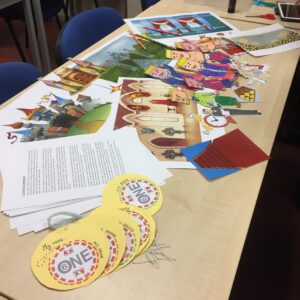
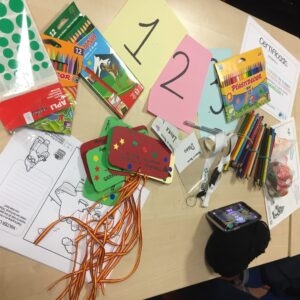
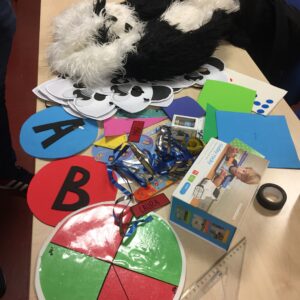
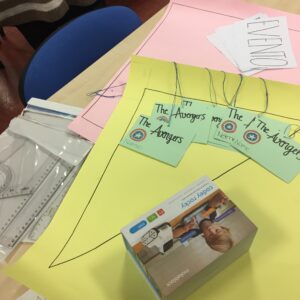
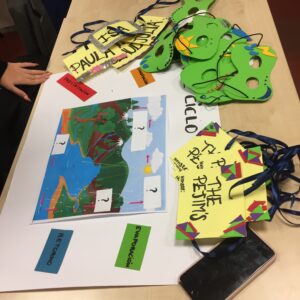
The next three weeks, my students will have a fantastic opportunity to work with real students from the schools who come to visit us at the Faculty of Education. Each group will be at our faculty one morning and will be with us (my group are students of the first year of the degree in Primary School, in the course of “Resources and ICT in education”) from 10:30 to 11:30 on Tuesday (each Tuesday we will work with different students).
This is a VERY punctual experience, but for my first year students I think it can be a perfect first contact with the students and also serve as an excuse to approach three technologies that can be used in the classroom (in this case we are going to use: stop-motion, augmented reality and robotics), and since we do not have robots for everyone, we have decided that each week 3 class groups work with a different activity on a rotational basis.
To try to make the most of this opportunity, I have asked my students to work with the students on Tuesday on an activity predesigned by me, open, small (minimum), adjusted, but for which they must plan the strategy to do it in practice. For each of the activities, I have given them a general guide to developing with the students and they, as teachers, have to prepare all the materials, resources, spaces, etc., to do it.
The idea is that, once we finish the activities with the students here (after March 26), my students will have also to develop three similar activities for an imaginary group of students. That is, one using stop-motion, one using augmented reality and one using robots. Those activities that they create later must be different from the ones I give them to use with the little ones, and they will be what they will exhibit this year in our traditional May fair.
The goal is for you to pay close attention to the details of the work of the next 3 Tuesdays and to the problems and ideas of the children who will be working with us.
This is the distribution of the activities to develop these days:
| |
5th of March |
12th of March |
26th of March |
| Stopmotion |
Expe
ICT Squad
Six in one |
Avengers
Facultad de papel
Oral B |
Pejims
Teacher in process
Squadra |
| Robots |
Avengers
Facultad de papel
Oral B |
Pejims
Teacher in process
Squadra |
Expe
ICT Squad
Six in one |
| Augmented Reality |
Pejims
Teacher in process
Squadra |
Expe
ICT Squad
Six in one |
Avengers
Facultad de papel
Oral B |
Some of these coming children speak some English, but most do not, so the activities will try to be flexible and our Erasmus students will play the role of teachers who only speak English (as an English teacher on their normal schools). However, due to time constraints, the activity should be completed in Spanish.
In addition, as for each activity, we have less than an hour, so we will have to be practical and try to survive the unforeseen in the best possible way:
So, before Tuesday, my students should:
- Read the activity carefully as soon as they can, make sure they understand correctly what they have to do and that they know how to do it with them.
- Any software to develop the activity must be installed on more than one device to work WITH their students. They should make sure they have it installed on at least two devices (always prepare a plan B for the technology) and that all of them are full of battery on Tuesday.
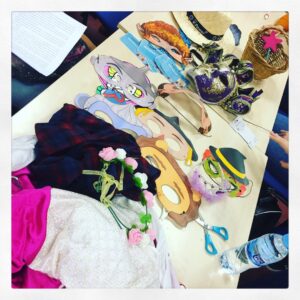
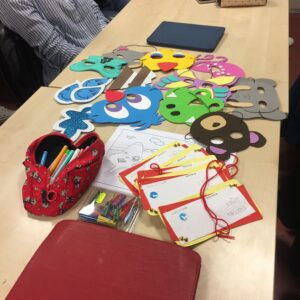
- Make sure they bring whatever physical things they would need to work with them (white and coloured papers, crayons, playdough, dolls, toys, rulers, rules for calculating angles, pencils, as many cards as you need…). Each group will work with a group of 5-7 students (depending on the day), and should bring enough material for all of them.
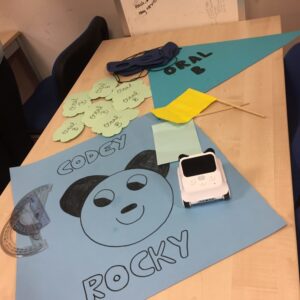
- For those who are going to work with robots, they will bring two different basic ways to create the paths: a square or one with more than 50 cm in length on the shorter side, and a scalene triangle whose shorter side is at least 40 cm.
- For those who are working with stop-motion: enough copies of the story they are going to represent and enough materials to represent it.
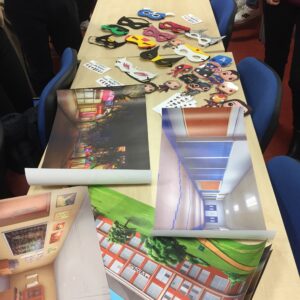
- For those using augmented reality, enough copies of the photo from https://chromville.com/wp-content/uploads/laminas/chromville_science/EN/Demo_water_cycle_trigger.pdf and a plan for encouraging them to work collaboratively.
- They should foresee the strategy of working with the learners (how to do the activity), plan it carefully and explain it on their blog.
- Stars and journalists should be responsible for collecting and publishing data and evidence of the work (photos, recordings, etc.) using the hashtag #rict1819. The Stars would be up of the children’s performance, and the journalists of their work as a group at that time.
- They should show in their blog the work of the children with a brief reference to how was the development of the hour, as well as the assessment standards (from the official CARM curriculum) of the subject that are being developed with this activity.
In addition to all this, it should be fun for the children and for us, but it should also be of benefit to both.
The truth is that seeing my students work this week preparing things, I am optimistic is going to be all fantastic … hopefully, it will go very well and that we learn many things from this experience.
In order not to collapse this blog too much, I will try to publish the approximations that my students make as the weeks, and we will see.
Oh! and if you want to see what we do, may be you can check our SNS activity here