Month: December 2024
Professorship Defense: my references
As I mentioned in the previous post, on the 10th, I defended my university professorship. I didn’t want to include a section for acknowledgements in the document because I didn’t want to introduce “such sentimentality” into a document that is so “formal and academic.” I fear it might undermine the importance, the imprint of effort, and the rigour (yes, I know I sometimes get carried away with formality and take myself too seriously), but instead, I included a final section, like an epilogue, to honour what I wanted to call “My Sources,” and I reproduce it here for you:
“Reaching this professional milestone results from constant and conscious work following a dynamic vision of what is essential in and for the university. This vision has gifted me with the best I have: my sources of inspiration.
First and foremost, I want to highlight my students as a source of inspiration. Each course, each subject, is a challenge. Trying to make the subject and our work in class memorable and worthwhile is an obsession. I sincerely hope to be quickly forgotten as a person, but I need the experience my students have at university, including in my class, to be professionally transformative. This goal drives me.
The curriculum that evidences my professional trajectory is the story of all the stories that have brought me to this moment. For me, it is much more than a sum of things—although it may be so for current academic evaluation models, I refuse to let my career be summarized as a sum of things. My professional journey is the residue of many classes—both received and given—tons of conversations, many discussions, thousands of defences, hours of chat, and the patience and wisdom of many people whose contributions form the layers that have built the vantage point from which I now view the world.
This project and my curriculum are a story of growth in a field of knowledge, of an epistemological, ideological, methodological, and academic proposal, of a way of doing, sharing, resisting, and attempting to influence.
I have the privilege of having worked—and continue to work—with dozens of people around the world (far beyond what a research group or usual network includes). All the people listed in my CV as co-authors—and many who are not listed—have gifted me moments that have helped me grow, reflections that have illuminated new perspectives, corrections that make me more readable, readings that have opened my eyes, doubts that have made me think more, questions that have made me ponder deeply, habits and quirks that have changed me. The projects included in this proposal—like most of the ones I undertake—have been discussed with many people, and I am inspired by the long and short moments these people have gifted me.
I’ve shared as much as I could these years and will continue to do so in the most orthodox formats and all those I consider relevant or interesting at any given moment. Beyond what “counts,” beyond what is “fundable,” I will continue doing so. Disseminating these years in varied formats, in diverse contexts, has taught me many things that I’ve put into practice in my way of researching my way of teaching, and it has made what we do reach places and people where research published in articles doesn’t usually go.
Having the opportunity to apply for a University Professorship represents an immense privilege and responsibility for me. I’ve reached this point in a concrete manner, which has implications that I accept and a price that I will continue to pay; it is my mission to be worthy of that privilege and that responsibility. Thanks to all the people and institutions that support me every single day to make this possible.”
And here in this post, taking advantage of this happy moment, and since it is no longer a formal context, I want to thank, besides my sources of inspiration—all of you who gift me with your conversation and time—my friends, those from Valencia, the Old Glories, the gang members, those from a thousand places who have been more than my co-authors and share my days and joys, those who wrapped me up when it was cold, those who made me feel surrounded even when I was alone, those who always believe in me and have the patience to love me despite being just me.
Thank you to everyone who has shared your joy over this achievement with me and feels it as their own. Thank you for the wonderful things you have said to me these days.
To my original family, my parents –my mom– for the privileges that allowed me to get here, and our family’s history that partly made me who I am. To my in-laws—brothers-in-law, sisters-in-law, and nieces and nephews (who make me an aunt even though I have no siblings)—to my in-laws—Arturo and Alicia—who are always with me in these “final” moments but live with me through all the intermediates, thanks for making me feel how proud you are of me.
To my family. To Alejandro, who makes me a better version of myself, who only cares that I’m happy, who is always on my team. To Raquel, who accompanies me to infinity and beyond, has gifted me some of the most exciting and fun conversations, the boldest plans I can think of, and has “rearranged” the world, our world, happily in many ways.
Gracias Totales.
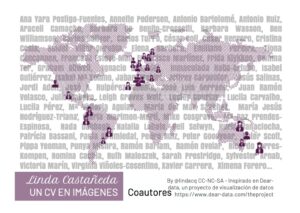

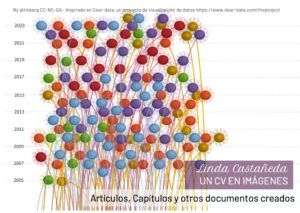

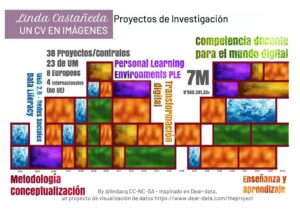

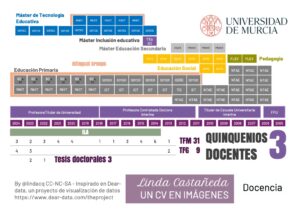

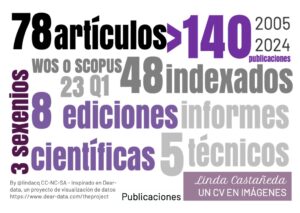

The images in this gallery are a series of postcards I created amid my concern of giving meaning to the CV beyond the idea of “farther, longer, more, higher.” I will publish the details of how I made them AND the slideshow in case you are interested in knowing. Yes, they are only in Spanish 😉
Professorship Defense ” Statement and Disclaimer”
Today, I successfully applied for a professorship in my area of expertise—Didactics and School Organization—at the Faculty of Education at the University of Murcia.
When I completed my work for the position of Associate Professor, I shared with you part of the process—it’s available in my post from September 12, 2018–. Today, that approach doesn’t make much sense to me (I can’t contribute much more, mainly due to the variety of processes and approaches in Spanish universities). However, I would like to share some reflections on how I prepared for the exam and what the document I’ve presented as my “Proyecto de Cátedra” means to me (my university’s regulations require this document). To do this, I will share with you a section of this document (which you will find here in a piecemeal fashion) that I’ve titled:
Professorship Statement and Disclaimer
“This work (referring to the project I presented to the panel who examined me) aims to be an academic reflection of what it means for me to aspire to a university professorship in Educational Technology. Perhaps because of this, I do not intend to make a definitive theoretical or epistemic stance. This work is not meant to be ‘my legacy’ or a declaration of what I intend my research to be from now on, precisely because the mission of an academic, at least from my point of view, should be reviewed, rethought, and redirected continuously.
It is an integrated proposal with short—or medium-term research projects that will likely evolve soon, and I hope it will continue to help me evolve in my understanding of the problems around me and the educational reality in a broad sense.
In this case, I intend to take a practical approach (without implying that all research should be “useful”) and an exploratory and critical approach. Although what I present is, in fact, a short-term bet, I believe it should reflect not only my current thematic and reflective stance but also my understanding of how research in Educational Technology should be conducted and the guiding questions I ask myself daily to pursue this field.
Hence, I understand that this proposal must respond to a series of fundamental characteristics:
- Address a substantive issue that affects or pertains to fundamental questions about the impact of technology on education, where the effect on education should be the priority.
- Be coherent, meaning to seek, develop, and give space to the paths opened by the research history.
- Dare to be innovative means looking in diverse places for different things. This implies advanced technology and an awareness of the most advanced problems. It also means exploring, sometimes even without knowing if there is something on the other side.
- Be epistemically committed, generating theoretical, methodological, and educational structures that give substance to new paths we must blaze in education. The goal is to light up areas others can walk through and, if possible, turn those paths into “roads.” This means keeping an eye on all new developments, but without rushing to any trend, and ensuring that someone follows the paths we trace…
- Be socially committed to the development of the context, in this case, to the development of my institution, my classroom, but also to other institutions like mine, and of course, to public education and what it entails.
- It should be bold, meaning rigorous, but also willing to find, test, learn, and even fail or find paths that cannot be travelled.
Interdisciplinary, understanding that education is not done solely by educators, giving place in the research to professionals who educate and those who shape the technological present, but keeping clearly in mind that the education of people (subjects in the community) is the priority in that multiple perspectives. - It must be communicated, transferred, and made usable by all those who may be addressed by it, not only by other researchers. For this, it must be open and frank, and I must make an effort to disseminate it.
I know many topics are not addressed in this text, but they are always there as a backdrop and a horizon to which to aspire. To name a few, I would start by saying that the redefinition of my field of knowledge—Educational Technology—that I tackled in my Associate Professor project and later worked on thoroughly with Professors Salinas and Adell (Castañeda et al., 2020) remains a crucial factor that must be kept fresh in any analysis of this nature. The training of teachers, which will be mentioned in the more distant futures of the last part of this document, is an irreplaceable horizon of extraordinary importance but one that we cannot address in this proposal. There is also a vast area of work related to the generation of knowledge by students—yes, referring to the DCCU—which we do not address in this work but should be addressed.
Additionally, many organizational, social, political, and economic constraints condition and limit—or try to limit—my research, but they do not depend on me. However, I have been aware of these constraints for many years and have been fortunate to conduct research that influences my immediate and not-so-immediate context, so I hope to continue dealing with them as I have so far and continue to influence them for the better.”
As you can see, it is a statement of intentions that I hoped would represent me. Because if there’s one thing I believe was necessary on a day like today—when the ANECA accreditation already says you’ve jumped farther, higher, better—it was a declaration of who I am and what I believe has brought me to this point and what I will do from here on. It is not very different from what I have been, but part of the charm, I suppose, lies in what I am willing to continue to be.