Selander & the #Rict1516 Fair

On May 17th, we celebrated -my students and myself, in the hall of the faculty, a new edition of our “Fair of Technology Enhanced Didactic Activities”. As you probably remember, last year we invite you to come 🙂 and after that, we show you a little of what had happened there.

This year, in addition to telling a bit of the story, I want to take advantage of this blog post to emphasize the rationale of that “show”, beyond its playful nature, the idea of being together and doing the students’ work more visible, as well as opening windows reality on the walls of our classroom.

I want to do it, because sometimes, the “lights” and “lanterns” of the fair, do not let us see everything that is an “event” like this, and maybe, make this reflection would help me to organize my thoughts and, who knows, maybe, this would encourage you to give me better ideas to improve it.

The Fair was created with the intention of serve as event presentation of the students’ work, but with the difference that, in this time, the work is assessed but not graded, i.e., is an event in where the goal is, specifically, to conduct a formative evaluation of the work (this is the final work of the course). Both by the teacher of the subject that gives feedback one to one to all groups, about all jobs; by other classmates that are passing by the exhibitors; by other students of the faculty who pass; as well as by other teachers of the faculty that can approach.

After the event, I put a “mark” (the 10% of the final grade for the course) for his staging of the work at the fair (effort, organization exhibitor, and exhibition, etc.), but they still have 2 and a half weeks to finish, profiling and “round up” their activity before the final submission of it for final summative evaluation and, of course, for the qualification.

This idea fits with the notion of The Secondary Transformation Unit, in the Learning Design Sequences described by Sttaffan Selander in his 2008 paper, and summarized quite well when he says::

A sequence starts when the teacher introduces a new task and sets the conditions for the work. The Primary Transformation Unit then entails the interpretation of the task and the setting, and the process of transformation and formation of knowledge – by way of different modes and media. The Secondary Transformation Unit starts with students presenting their work. If the goals, as well as the expectations of the process and the product, are clearly defined and explained in the beginning, both students and teachers will have a powerful tool for reflection and evaluation. During the whole sequence, teachers make interventions and have the possibility to reflect on the signs and indications of learning that occur during the process. (Selander, 2008: 15)

Thus, Selander represents the complete sequences bellow
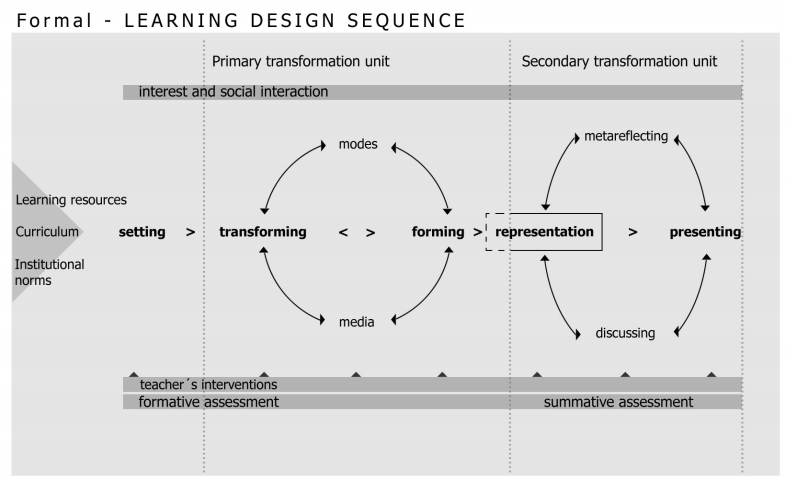
"Learning Design Sequences". Sellander, 2008.
“Learning Design Sequences.” Selander, 2008.

It is, as we told you last year in the JUTE (Castañeda, Adell & Llopis, 2015), getting foster “a second part of learning, beyond the feedback of the task; getting a third phase in which the possibility of remaking the task under the light of that feedback, as well as reflect on what was learned in the process”, get to think and rethink what we are creating, allow us to learn more and better.

We’ll see 😉

REFERENCES:

Selander, S. (2008). Designs for learning: A theoretical perspective. Designs for Learning, 1(1), 10-23 Disponible en http://doi.org/10.16993/dfl.5

Castañeda, L. Adell, J. & LLopis, M.A. (2015). Cinco años de reflexiones y diálogos docentes a propósito de la asignatura de Tecnologías Aplicadas a la Educación. Comunicación presentada a las JUTE 2015. Badajoz, mayo de 2015.

By the way! If you want to see how was the show this year, here are some of super-dinosaur footprints:

Tools on the Bloom’s eyes

If you’ve been here sometimes before, surely you shall know that I do not think that, after 60 years since its publication, we have to keep -“almost with devotion”- looking at the famous “Bloom’s Taxonomy” (here’s the explanation http://www.lindacastaneda.com/Mushware/nobloom /).

However, when I’m asking my students to design an ICT enriched educational activity, where ICT could do more than decoration, and also where they could get from their future students, much more than repetition or identifying, I find tremendously useful the approach to ICT from the Bloom’s Taxonomy perspective, but Bloom’s understood as a list of “thinking skills”.

As a final artifact of that exercise to start thinking about how to develop higher order thinking skills using ICT (Wow! indeed this is the goal), I have taken this year “borrowed” an idea that I saw in the educatorstechnology Blog , and I have asked to my students if they would find a tool of the web 2.0, and would propose an activity they could design with that tool that helps to develop each Bloom’s Taxonomy thinking skills (at least one activity for each thinking skill), and if they would express the list, creating a table / infographic / image that gathers together.

Now it’s time to share them with you on the Pinterest board where we have put together and, hopefully, over the years can be made larger.


My GITE’s Seminar: Basic readings about Educational Technology Vol. 1.

For some years, GITE has been conducting seminars in which each of us shares with the other members of the group, something of what concerns us, what we are working on, or what attracts our attention in the last times of our professional life.

Particularly, I have to confess that I always have the impression of not having read everything that I could about educational technology. So, when I saw the compilation made by my host at Oxford University Chris Davies and Rebbeca Eynon’s “Educational Technology” (Editing by Routdledge in 2016), and I had the opportunity to review the content index, I understood that it was a wonderful.

It is not a normal book, it is a book that includes a selection of the most relevant articles that can give you an initial perspective about ET. That is to say, it is not a matter of who invented the wheel, and of which are the fundamental bases to understand the development of that wheel; It does not include the initial article of all topics, but sometimes includes later articles that reflect some of the discussion that provoked that topic.
Obviously, like any selection other experts will find it to be improved, but I think it is quite good.

The book includes four complete volumes, and I decided that I would dedicate my GITE seminars to introduce each one of them, in a form of commented readings seminars.

So, on this occasion and to begin with I have dedicated to Volume One which include the following documents:

Part 1: Perspectives on the Nature of Technology and its Place in Human Lives in the Modern World

  • Langdon Winner, ‘Do Artifacts Have Politics?’, Daedalus, 1980, 109, 1, 121–36.
  • Castells, ‘Informationalism, Networks and the Network Society: A Theoretical Blueprint’, The Network Society: A Cross-cultural Perspective (Edward Elgar, 2004), pp. 3–48.
  • Martin Oliver, ‘Technological Determinism in Educational Technology Research: Some Alternative Ways of Thinking About the Relationship Between Learning and Technology’, Journal of Computer Assisted Learning, 2011, 27, 15, 373–84.

Part 2: Forming and Configuring the Field of Educational Technology

  • Seymour Papert, ‘Computers and Computer Cultures’, Mindstorms: Children (Basic Books, 1980), pp. 19–37.
  • Larry Cuban, ‘Computers Meet Classroom: Classroom Wins’, Teachers College Record, 1993, 95, 2, 185–210.
  • Richard E. Clark, ‘Media Will Never Influence Learning’, Educational Technology Research and Development, 1994, 42, 2, 21–9.
  • Hank Bromley, ‘The Social Chicken and the Technological Egg: Educational Computing an the Technology/Society Divide’, Educational Theory, 1997, 47, 1, 51–65.
  • Kenneth R. Koedinger, John R. Anderson, William H. Hadley, and Mary A. Mark, ‘Intelligent Tutoring Goes to School in the Big City’, International Journal of Artificial Intelligence in Education, 1997, 8, 30–43.
  • Anohina, ‘Analysis of the Terminology Used in the Field of Virtual Learning’, Educational Technology & Society, 2005, 8, 3, 91–102.
  • Czerniewicz, ‘Distinguishing the Field of Educational Technology’, Electronic Journal of e-Learning, 2008, 6, 3, 171–8.
  • Neil Selwyn, ‘Making the Most of the “Micro”: Revisiting the Social Shaping of Micro-computing in UK Schools’, Oxford Review of Education, 2014, 40, 2, 170–88.

Part 3: Foundational Theories and Perspectives on the Capacity of Technology to Transform Learning

  • Skinner, ‘Teaching Machines’, Science, 1958, 128, 3330, 969–77.
  • J. Gibson, ‘The Theory of Affordances’, The Ecological Approach to Visual Perception (Erlbaum, 1979), pp. 127–43.
  • Marlene Scardamalia and Carl Bereiter, ‘Computer Support for Knowledge-Building Communities’, Journal of Learning Sciences, 1994, 3, 3, 265–83.
  • Roy D. Pea, ‘Seeing What We Build Together: Distributed Multimedia Learning Environments for Transformative Communications’, Journal of the Learning Sciences, 1994, 3, 3, 285–99.
  • Mercer, ‘The Quality of Talk in Children’s Joint Activity at the Computer’, Journal of Computer Assisted Learning, 1994, 10, 24–32.
  • Crook, ‘Children as Computer Users: The Case of Collaborative Learning’, Computers and Education, 1998, 30, 3–4, 237–47.
  • James Paul Gee, ‘Semiotic Domains: Is Playing Video Games a “Waste of Time”’, What Video Games Have to Teach Us About Learning and Literacy (Palgrave Macmillan, 2003), pp. 13–50.
  • Siemens, ‘Connectivism: A Learning Theory for the Digital Age’, International Journal of Instructional Technology and Distance Learning, 2005, 2, 1, 1–8.


Part 4: Theories of Learning and Teaching Underpinning Educational Technology Practice

  • Lev Vygotsky and Alexander Luria, ‘Tool and Symbol in Child Development’, in M. Cole, V. John-Steiner, S. Scribner, and E. Souberman, Mind and Society: The Development of Higher Psychological Processes (Harvard University Press, 1978), pp. 19–30.
  • Fred S. Keller, ‘”Goodbye Teacher …”’, Journal of Applied Behavior Analysis, 1968, 1, 1, 79–89.
  • Lave, ‘Situated Learning in Communities of Practice’, in Lauren B. Resnick, John M. Levine, and Stephanie D. Teasley (eds.), Perspectives on Socially Shared Cognition 2 (1991), pp. 63–82.
  • Jonassen, ‘Objectivism Versus Constructivism: Do We Need a New Philosophical Paradigm?’, Educational Technology Research and Development, 1991, 39, 3, 5–14.
  • Anna Sfard, ‘On Two Metaphors for Learning and the Dangers of Choosing Just One’, Educational Researcher, 1998, 27, 2, 4–13.
  • Pierre Dillenbourg, ‘What Do You Mean by Collaborative Learning?’, in Dillenbourg (ed.), Collaborative-Learning: Cognitive and Computational Approaches (Elsevier, 1999), pp. 1–19.