When Sarah Prestridge invited me to give a seminar at the Griffith Institute for Educational Research in Brisbane, I found myself with one of those wonderful problems that academic invitations sometimes bring: I could talk about practically anything I wanted. I could have chosen one of my research strands, presented a recent project or, inevitably, given yet another seminar on AI and education.
I had also been preparing several of the seminars I am giving in Sydney, at UTS, which together form Educational Optics: using different optical devices — the prism, the lens, the mirror — to ask what the emergence of AI is allowing us to see about educational problems that did not, in fact, begin with AI.
But those seminars also have another purpose: to make some of my questions accessible to people who are not necessarily close to the things I usually work on — people at CIC and around it. For Griffith, I wanted to do something different. The audience was made up of education people. And that gave me the chance to come home, intellectually speaking: PLEs, agency, learning design, teacher competence, sociomateriality, digital transformation, education policy… apparently different things that I have been working on for years, and that I did not want to turn into a parade of projects or publications.
The question was how to put them together.
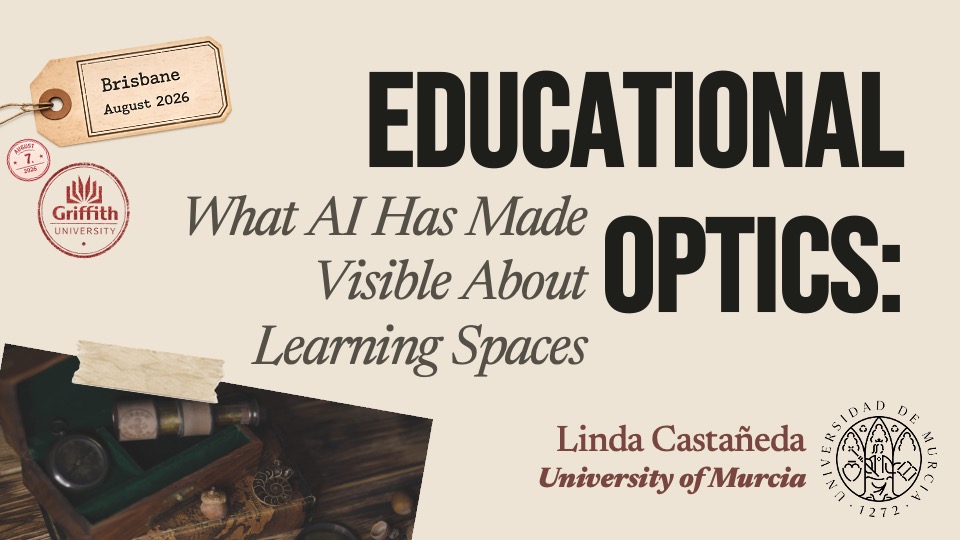
A TRAVELLER’S NOTEBOOK
The first decision that ended up bringing everything together was, curiously enough, a visual one. I have a travel notebook for this stay in Australia. I brought it with the intention of filling it with maps, tickets, scraps of paper and things I picked up along the way. Of course, I never seem to find the time to actually fill it in, although I have been carefully collecting all those things in the hope that, at some point, I will manage to stick them in.
So, if this seminar was happening in the middle of a journey, why not build it as a traveller’s notebook? I did not want a vintage aesthetic simply because it looked nice. I was thinking about those notebooks where you stick things you collect along the way: maps, photographs, tickets, notes, drawings, pieces of paper that come from different places and that, when placed next to each other, begin to tell a story that none of them could tell on its own.
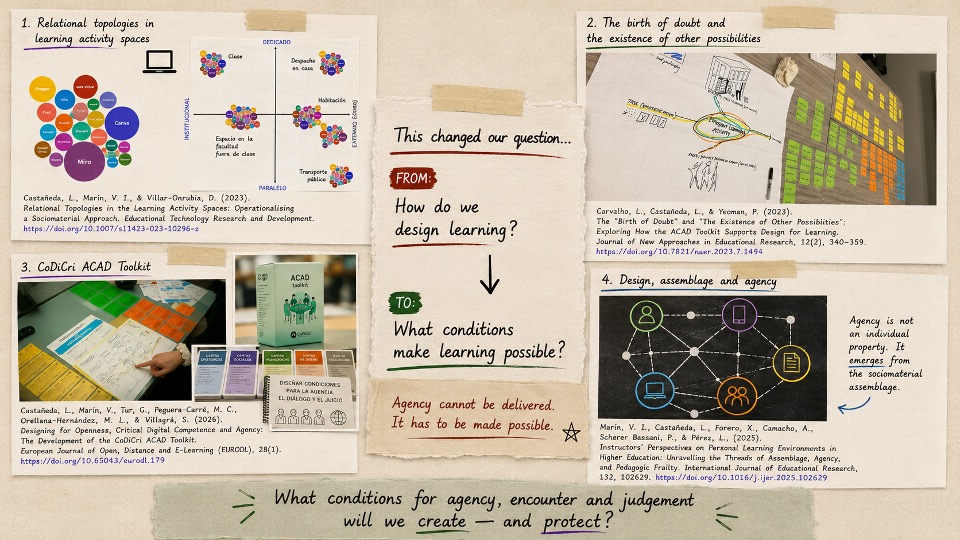
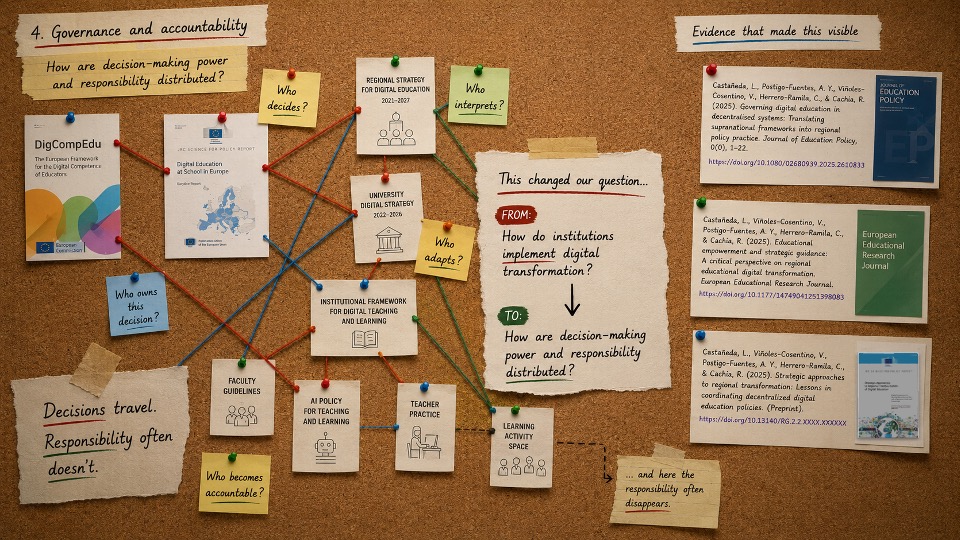
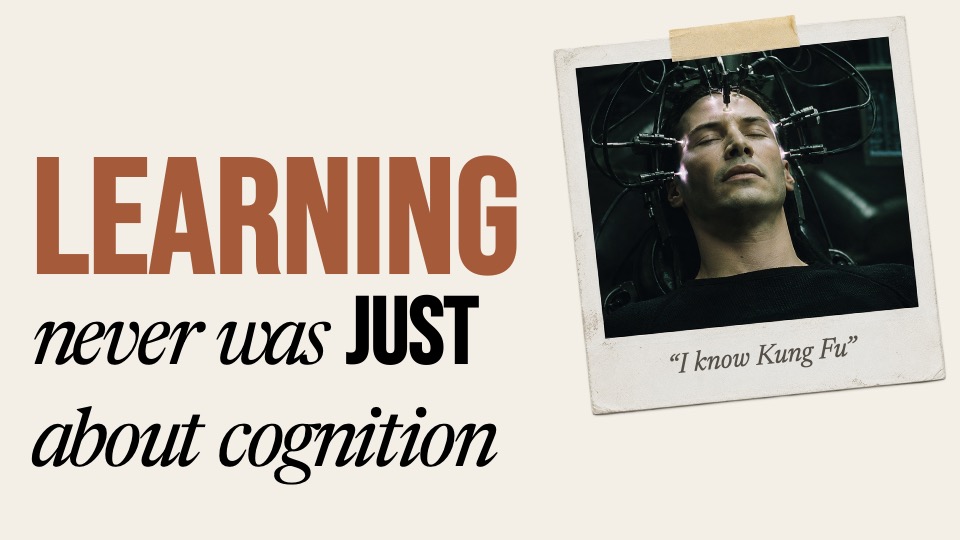
That was exactly what I wanted to do with my research. And so came the maps, stamps, Polaroids, pen-and-ink drawings, scraps of paper, references written as notes and, above all, real diagrams and images recovered from previous research. I did not want to redraw everything to make it look new. Quite the opposite: I wanted the traces of the journey to remain visible.
And then the aesthetics began to help me think about the structure. The seminar was eventually titled:
Educational Optics: What AI Has Made Visible About Learning Spaces
That meant I had to start with AI, but I did not want to stay there for too long. I used the idea of optics years ago and I still find the metaphor very useful, so I brought it back, trying to give it a different form.
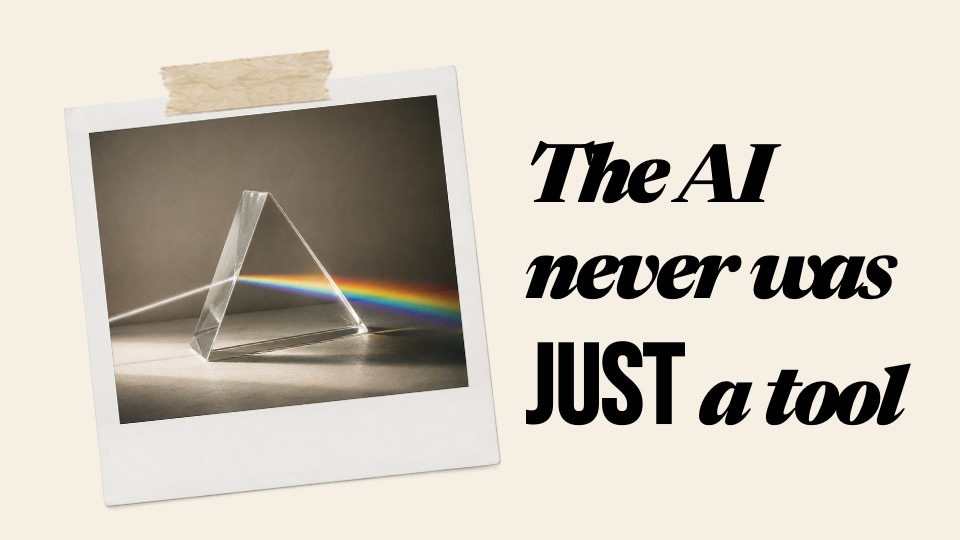
I returned to the idea of the prism that I had explored in another of the seminars: if we focus our attention exclusively on technology, we run the risk of technology mystifying rather than clarifying what is actually happening. AI could help me do precisely the opposite: separate questions that are often mixed together and look at education again through them.
But what I wanted to look at was learning spaces. And that was where the first journey backwards began.
I went back to PLEs, but not to explain PLEs all over again. I went back to work on agency, teacher competence, learning design, digital transformation and governance. And, while preparing the seminar, something happened that I particularly enjoyed: as I placed work that had emerged at different times and around different objects next to each other, connections began to appear that I had not thought about in quite that way when I did each piece of research.
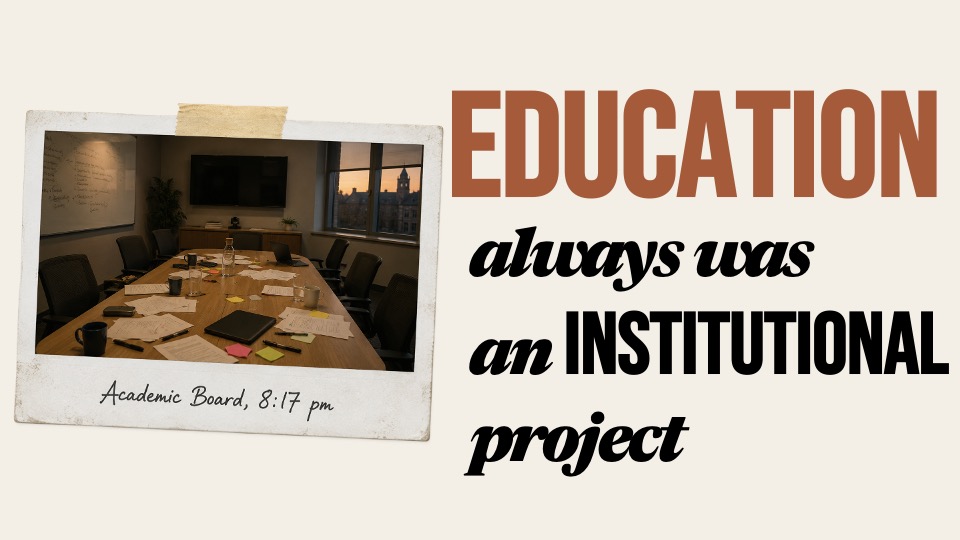
The questions also began to change scale: from how we learn in a world of abundance to what it means for a teacher to be able to judge and decide; from the conditions we design to make something possible to who has the power to decide about those conditions and who is accountable for those decisions.
And that was when I realised that I did not need to manufacture a conclusion. Besides, I like asking questions. I think I think better through questions. So the seminar ended up leaving some rather big ones open: what kind of education do we want to make possible; what do we expect teachers to be able to notice, decide and justify; what conditions do we want to create and protect for agency, encounter and judgement; and how do we distribute decision-making power and responsibility for those decisions?
Because I did not want this to be just a seminar, but the beginning of a conversation with some of the people there — a conversation that could start on that very occasion — I added a slide with a link to the work underpinning the journey I was sharing with them.
And then I felt a small pang of embarrassment.
Because I was reconstructing the argument through my own research trajectory, the list was inevitably full of my own publications. So I added a note that felt important to me:
These publications are only entry points. Their reference lists matter just as much: they point to the work and the scholars on whose shoulders these ideas were built. Feel free to ignore what I wrote — but do follow the references. They will take you to the wonderful people and ideas I have been lucky enough to think with.
Because no intellectual travel notebook contains only our own traces. It is full of the people we have read, those we have worked with, conversations that have made us change a question, ideas we have borrowed, and others that have forced us to let go of certainties.
And perhaps that is what Educational Optics at Griffith ultimately became: not a collection of findings, nor a synthesis of twenty years of research, but an opportunity to open the notebook, spread some of its pages out on the table, and ask myself what I could see now that I had not known how to see when I wrote them separately.
Sometimes preparing a seminar is useful precisely for that. Not for discovering that you have been asking the same question for twenty years, but for recognising, when you look back, which concerns have managed to survive all the questions you have changed along the way.
Now I just need to find the time to fill in the actual notebook. 🙂
Este trabajo es resultado de la estancia 22871/EE/25 financiada por la Fundación Séneca-Agencia de Ciencia y Tecnología de la Región de Murcia con cargo al Programa Regional de Movilidad, Colaboración e Intercambio de Conocimiento “Jiménez de la Espada”